Implementation of network saving and loading for NeuroTIC. More...
#include "ntfile.h"#include "ntbuilder.h"#include "ntmemory.h"#include <stdio.h>#include <string.h>#include <math.h>#include <stdlib.h>#include <float.h>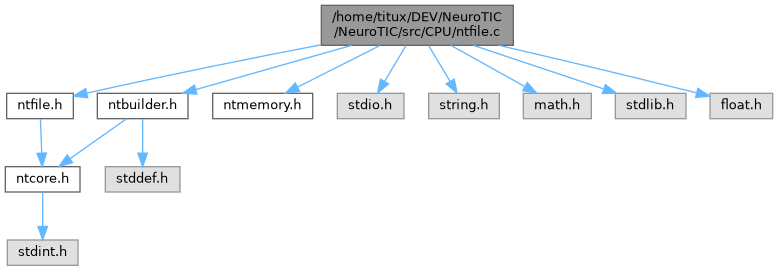
Go to the source code of this file.
Macros | |
| #define | NAME_LENGTH 30 |
| #define | MAGIC "NeuroTIC" |
| #define | VERSION 0x0 |
Functions | |
Endianness and Floating-Point Handling | |
The STRICT_LE16 and STRICT_LE32 macros ensure that data is written in little-endian format, regardless of the host system's endianness. /
#define STRICT_LE16( x ) &( uint16_t ){ little_endian ? ( x ) : bswap16( x )}
#define STRICT_LE32( x ) &( uint32_t ){ little_endian ? ( x ) : bswap32( x )}
uint8_t checkendian( void ){
uint16_t x= 1;
return *(uint8_t *)&x;
}
uint16_t bswap16( uint16_t x ){
return ( x >> 8 ) | ( x << 8 );
}
uint32_t bswap32( uint32_t x ){
return
( ( x >> 24 ) & 0xFF ) |
( ( x >> 8 ) & 0xFF00 ) |
( ( x << 8 ) & 0xFF0000 ) |
( ( x << 24 ) & 0xFF000000 );
}
uint8_t isieee754( void ){
return
( sizeof( float ) == 4) &
( FLT_RADIX == 2 ) &
( FLT_MANT_DIG == 24 ) &
( FLT_MAX_EXP == 128 );
}
typedef struct{
uint8_t sign;
int32_t e;
float m;
} float_parts_s;
uint32_t float32( float x , uint8_t ieee754 ){
uint32_t result;
float_parts_s float_parts= {0};
if( ieee754 ){
memcpy( &result , &x , sizeof( float ) );
return result;
}
float_parts.sign= x < 0.0f;
if( ( x= fabsf( x ) ) == 0.0f ) return 0;
float_parts.m= frexpf( x , &float_parts.e );
if( float_parts.e <= -126 ) return ( float_parts.sign << 31 );
if( float_parts.e >= 129 ) return ( float_parts.sign << 31 ) | ( 0xFF << 23 );
return ( float_parts.sign << 31 ) |
( ( uint32_t )( float_parts.e + 126 ) << 23 ) |
( ( uint32_t )( ( float_parts.m * 2.0f - 1.0f ) * ( 1u << 23 ) + 0.5f ) & 0x7FFFFF );
}
float floatsys( int32_t x , uint8_t ieee754 ){
float result;
if( ieee754 ){
memcpy( &result , &x , sizeof( float ) );
return result;
}
float_parts_s float_parts= { .sign= ( x >> 31 ) & 1 , .e= ( x >> 23 ) & 0xFF , .m= ( float )( x & 0x7FFFFF ) / ( 1u << 23 ) };
if( float_parts.e == 0 && ( x & 0x7FFFFF ) == 0 ) return 0.0f;
if( float_parts.e == 0 ) float_parts.e= -126;
else {
float_parts.m+= 1.0f;
float_parts.e-= 127;
}
result= ldexpf( float_parts.m , float_parts.e );
return float_parts.sign ? -result : result;
}
| |
| unsigned char | savenet (net_s *net, const char *name) |
| Saves a network to a binary file with extension .ntic. | |
| struct net_s | loadnet (char *name) |
| Loads a network from a binary file with extension .ntic. | |
Detailed Description
Implementation of network saving and loading for NeuroTIC.
Provides functions to persist network structures and weights, allowing training to be stored and reloaded.
The file format is binary with a custom structure, including endianness and floating-point representation handling for cross-platform compatibility.
Currently, the implementation focuses on core data serialization and deserialization, with future plans for validation and standardization of loaded data.
- Todo:
Implement file validation and data standardization during loading to ensure compatibility and integrity of loaded networks.
Consider adding support for versioning in the file format to allow for future extensions and backward compatibility.
Explore options for compressing the saved network files to reduce disk space usage, especially for larger networks.
- Date
- 2026
Definition in file ntfile.c.
Macro Definition Documentation
◆ MAGIC
| #define MAGIC "NeuroTIC" |
◆ NAME_LENGTH
| #define NAME_LENGTH 30 |
◆ VERSION
| #define VERSION 0x0 |
Function Documentation
◆ loadnet()
| struct net_s loadnet | ( | char * | name | ) |
Loads a network from a binary file with extension .ntic.
Reconstructs the network structure, weights, biases, and buffer wiring from a binary file.
The function reads the file header to validate the format and version, then proceeds to read the core network data while handling endianness and floating-point representation.
- Todo:
Implement file validation and data standardization during loading to ensure compatibility and integrity of loaded networks.
Consider adding support for versioning in the file format to allow for future extensions and backward compatibility.
Explore options for compressing the saved network files to reduce disk space usage, especially for larger networks.
References wiring_s::array_type, wiring_s::arrays, neuron_s::b, neuron_s::bff_idx, buildnet(), neuron_s::fn, neuron_s::inputs, net_s::inputs, net_s::layers, net_s::neurons, newnet(), net_s::nn, wiring_s::size, wiring_s::src_index, wiring_s::src_layer, wiring_s::src_type, neuron_s::w, and net_s::wiring.
◆ savenet()
| unsigned char savenet | ( | net_s * | net, |
| const char * | name | ||
| ) |
Saves a network to a binary file with extension .ntic.
Saves the network's layers, neurons, weights, biases, and buffer wiring to a binary file.
The file is structured with a header containing a magic string and version byte, followed by the network's core data.
The function handles endianness and floating-point representation to ensure cross-platform compatibility.
- Todo:
Add validation checks for the input network structure before attempting to save, ensuring that all necessary data is present and correctly formatted.
Implement error handling for file operations, such as checking for write permissions and handling disk space issues.
Consider adding metadata to the file format, such as timestamps or training information, to provide more context when loading networks in the future.
Explore options for compressing the saved network files to reduce disk space usage, especially for larger networks.
Implement file validation and data standardization during loading to ensure compatibility and integrity of loaded networks.
References wiring_s::array_type, wiring_s::arrays, neuron_s::bff_idx, neuron_s::fn, neuron_s::inputs, net_s::layers, net_s::neurons, net_s::nn, wiring_s::size, wiring_s::src_type, and net_s::wiring.